Not All Neurofeedback Is the Same
If you’ve started researching neurofeedback, you’ve probably noticed that it means different things depending on where you look. Some systems require a clinician to map your brain before every session. Others use electromagnetic signals. Some are done in a clinical office; others you can rent and use at home.
Then there are the devices on Amazon calling themselves neurofeedback that aren’t really neurofeedback at all.
This is a plain-language guide to what actually separates the different types, so you can understand what you’re considering before you start.
Linear Neurofeedback
Linear neurofeedback is the oldest form, developed in the 1960s and 70s. It works by identifying brainwave patterns a practitioner believes are out of range, then designing a protocol to correct them. During a session, the brain gets rewarded — usually through a visual or audio signal — when it produces the target pattern.
It requires ongoing practitioner involvement. The clinician decides which frequencies to train, monitors your progress, and adjusts protocols over time based on their interpretation of your brain activity. Sessions happen in a clinical setting, usually on a regular schedule.
It’s a structured, directive approach. The practitioner determines what the brain should be doing and the system works to get it there.
LENS (Low Energy Neurofeedback System)
LENS takes a different approach. Rather than training toward a target, it aims to interrupt stuck patterns by sending a tiny electromagnetic signal while monitoring EEG activity. The idea is that a brain locked into a rigid loop can be helped to loosen and reorganize.
Sessions are short and passive. You don’t concentrate or try to do anything. Some people notice shifts quickly. A trained practitioner still manages the process and makes decisions about how to proceed.
Dynamical Neurofeedback (NeurOptimal®)
Dynamical neurofeedback works on a different principle than either of the above.
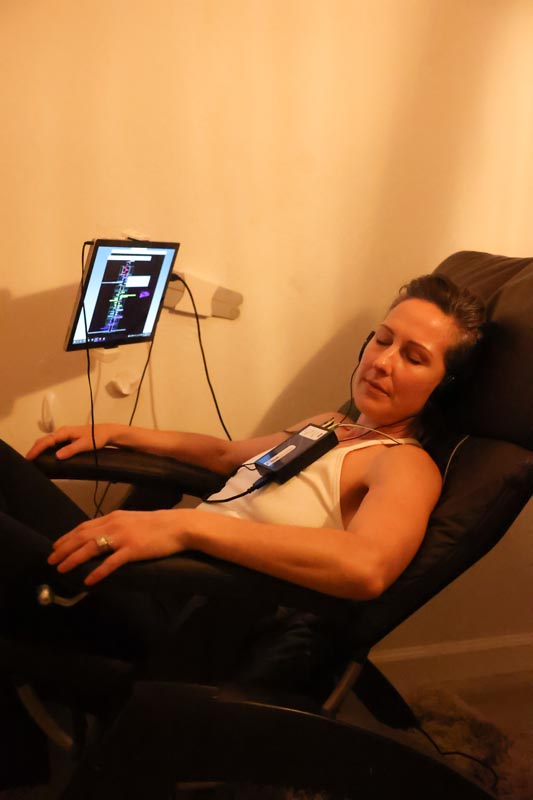
Instead of directing the brain toward a target state, the system reads your brain’s electrical activity in real time and reflects information back to it through subtle pauses in the audio or film you’re watching. When the brain detects those micro-interruptions, it naturally checks in with itself. Over time, it gets better at self-correcting without the prompt.
Nothing is being pushed. No one is deciding what your brain should be doing or selecting frequencies to change. The system provides information and the brain decides what to do with it.
We chose NeurOptimal® at Bay Area Brain Spa because it fits how we think about the nervous system. The brain is not a problem to be corrected. It’s an incredibly intelligent self-organizing system that, given the right information, knows how to find its own balance. Our job is to give it that information and get out of the way.
Sessions are effortless by design. No effort, no targets, nothing to do right or wrong. Members at our Albany studio get the same system available for home rental, so training can continue between visits.
What About Those Devices on Amazon?
Searching “neurofeedback device” online returns a lot of headbands and headsets in the $200-$500 range. Most of them are not neurofeedback. They’re entrainment.
Entrainment uses external stimuli — binaural beats, pulsed light, specific sound frequencies — to guide the brain toward a target state. It can feel pleasant and produce a temporary effect. But it’s a one-way signal going into the brain, not a feedback loop between the brain and a system reading its activity. When the device comes off, the brain returns to its habitual pattern. No new flexibility is being built. No lasting self-regulation is being trained.
Real neurofeedback reads your brain and responds to it. The information comes from your brain, not at it. That distinction changes everything about what happens over time.
For a deeper look at the difference, read our post Neurofeedback vs. Entrainment: What’s the Difference?
Which Type Is Right for You?
For most people looking to sleep better, feel less reactive, think more clearly, or simply get their nervous system out of a stuck pattern, dynamical neurofeedback is a strong place to start. It works without a diagnosis, without clinical protocols, and without a practitioner deciding what your brain should be doing. The system reads your brain and responds to it. Your brain does the rest.
We’ve worked with thousands of clients at Bay Area Brain Spa across a wide range of goals — stress, sleep, focus, anxiety, recovery, performance — and the results speak for themselves. NeurOptimal® doesn’t need to know what’s wrong with you to help you feel better.
One thing all neurofeedback approaches have in common: it’s a training, not a treatment. One session will give you a sense of what it feels like, but lasting change comes from accumulating sessions over time. Think of it like learning a language or going to the gym. The brain is building new patterns, and that takes repetition.
Clinician-directed neurofeedback typically runs $120 or more per session. At Bay Area Brain Spa, sessions start at $50. Our most popular starting point is the 5-session pack for $250, which gives your brain enough repetitions to start showing real change. Members who want to train consistently find that a monthly membership is the most cost-effective way to build the session volume that creates lasting results.
See membership options or take the 1-minute quiz to find out where to start.
Experience the Evolution Yourself
You don’t have to understand every brainwave to feel the difference.
Come relax in one of our cozy neurofeedback chairs, or train from home with our simple take-home system.
Calm your mind. Recharge your system. Let your brain do what it does best—find balance.